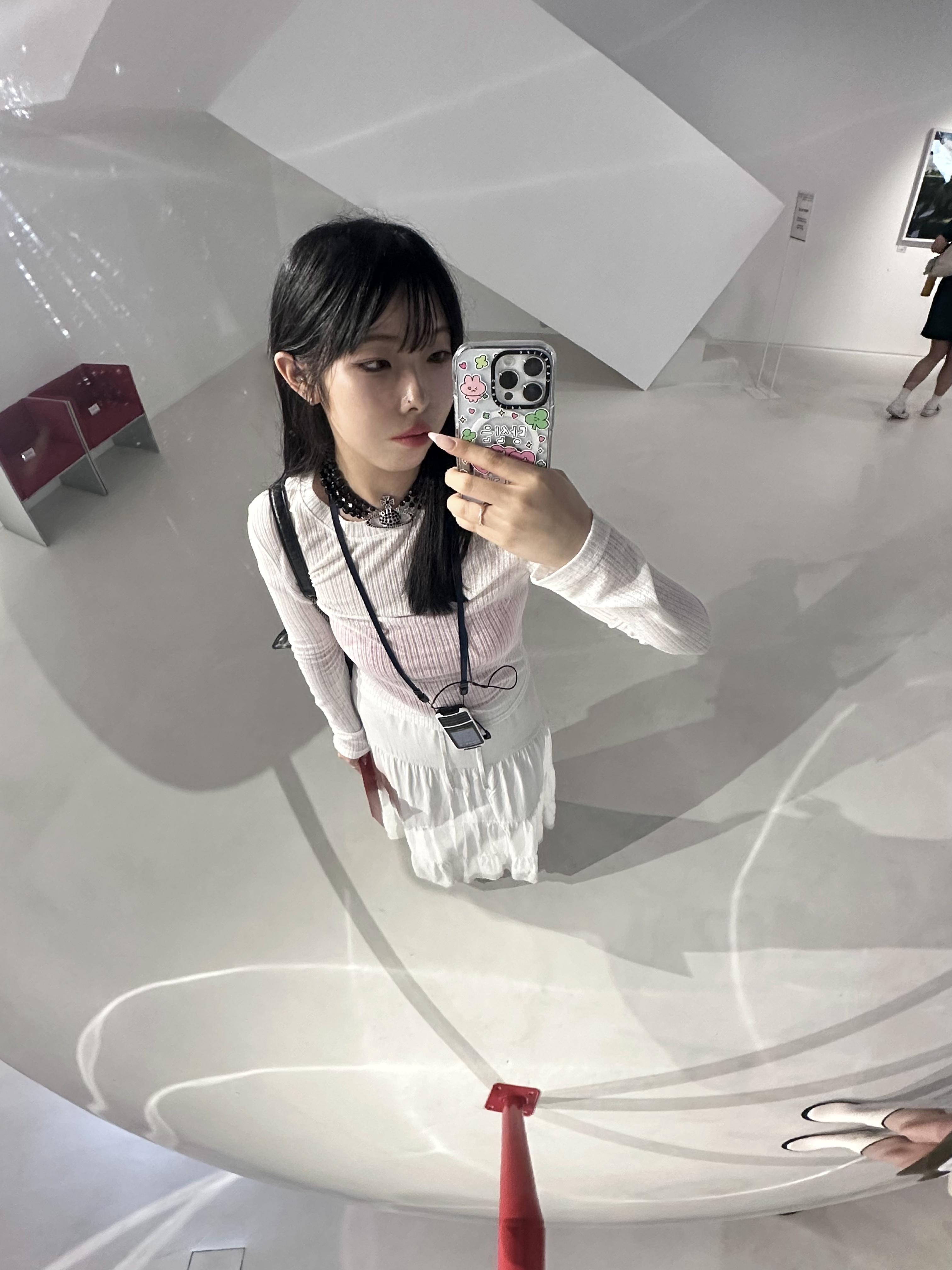

Welcome to my page ^^

I am Becky ji, a student of MA Digital Media, University of leeds. Big fan of K-POP. I also enjoy films and reading, love cooking and exploring coffee shops and bakeries!

WEEKLY REFLECTION

WEEK 1

This week's lecture gave an overall introduction to the module. The comparison between digital media and new media was mentioned, and the three key concepts of digital media - convergence, participation, and data-driven - were explained in detail. Although these three key concepts may sound abstract when summed up in a single word, they were illustrated and explained through the use of real-life examples. Such as the digital practices of the users of Tik Tok's filters, which increase the sense of participation of the users. This is what characterises the 'participation' of digital media.

Although there was no hands-on practical exploration this week, I think it's a good start. It's given me some theoretical grounding in digital media practices that I've never been exposed to before. These close to everyday life instructions have eased insecurities and nerves to a certain extent, adding confidence in my future studies.


WEEK 2

Before this week's workshop I completed an introductory course on website structure and css on linkedin as part of my preparation for the course. lLearning about the basic structure of html and some basic coding components, such as headings, paragraphs, and some css code writing. By writing down some basic framework of these codes in my notebook, I hope that it would help in practice.

However, in Friday's workshop, even though understood how to build a website, I was confused by the applications and operations required to build a website. Although we were familiar with the software after following the teacher's instruction, I didn't know what the file manager and folders other than editing code could do for a web page, and how these files and the editor would be connected and work together to build a website.

It turns out that building a website does not only require familiarity with coding, but also requires the help of multiple applications, so there is still a lot for a beginner to explore!

WEEK 3

In this week we have been working on website scraping. After last week's experience and the preparation for the lesson, it became clear to me that, despite the theoretical knowledge gained through online resources, the process of website scraping in practice would not be something that could be quickly familiarised with. In the classroom task, because of the settings of my laptop's browser, the pop-up function on my computer did not work properly, which resulted in me not being able to jump to the code page of the programme I chose when looking for the code of the website. However, with the help of my classmates, I was able to use the Google Groups plugin to quickly grab information about the programme through the tool that assisted me in the subsequent web scraping process.

WEEK 4

This week in the course we were asked to work in groups on a data analysis task. However, at the beginning of the task our discussion was bogged down by the choice of data topic to be studied. Firstly, based on the scenarios associated with analysing university campuses, we really wanted to choose topics that would be meaningful and truly insightful into the lives of students, but at the same time, data that would be easy to capture and to follow. Eventually we settled on conducting a study of restaurants and cafes on campus of Leeds university. Examples include analysing the reasons for the most popular restaurants in schools, comparing price differences between menus and off-campus, and finding the factors that influence students to make restaurant choices. Regarding the source of data, we believe that it can be extracted from Google maps as well as from the official social media accounts of these restaurants as well as their official websites. At first,I was hesitant because of privacy issues, but with Holly's help, we learnt that we could use data from websites and social media accounts that were open to the general public without asking for permission, which helped us in our next steps. And the part about the impact of data analysis collection,that's something that we need to continue to follow up on as well as discuss as a group. Although there are some ideas about the variables, we still need to think more carefully about the variable tables in order to get more rigorous results about data selection.

WEEK 5

This week's reading: ‘Who Gets Shipped and Why?’, It relies on fan-submitted metadata from platforms like AO3 and Fanlore to quantify shipping trends

The production of the data visualisation content in the study focused on interactive storytelling and easy-to-understand design, reflecting fan trends through innovative graphics.

Firstly the researchers utilised dynamic visuals, which allowed users to explore various dimensions of trends such as character gender, pairing types and specific fan patterns. Interactive filters allow users to focus on specific fans or relationships, customising the experience based on individual curiosity, which broadens the research layers and segments of this cultural study.

Also worth analysing is the clear and interesting aesthetic in the visual data presented in the study. The graphs, charts and flowcharts are stylised with bright colours and intuitive layouts, giving them an intimate feel. This aesthetic reflects the passion of fan culture. The design minimises technical complexity, making the data easy to read for even the casual reader. This also corresponds to a point highlighted by Holly at the workshop, that when practising visual data analysis, it is important to consider the use of colour and the strength of contrast, which allows the data to be presented to the reader in a clearer and more understandable way.

Since the topic of my dissertation is related to fan culture exploration, I think this reading provides implications for the data visualisation part of my thesis that I might devise.

WEEK 6

Laura Forlano's (Hacking the Feminist Disabled Body) explores the intersection of feminism, disability and technology. Forlano examines how socio-technical systems such as wearable medical devices shape the experience of chronic illness and disability.

Forlano redefines ‘hacking’ as a feminist practice that emphasises the creative reworking of wearable medical devices and prosthetics to better meet the needs of people with disabilities. Drawing on feminist science and technology studies, she critiques the proprietary and exclusionary nature of some traditional medical technology designs. The use of hacking not only empowers users but also challenges systemic inequalities. Specific elements include resisting proprietary systems, advocating for open source solutions, and promoting participatory design processes centred on user autonomy. Hacking becomes a tool for challenging systemic inequalities, creating technologies that empower disabled people's bodies and safeguard and promote their autonomy over health and care practices.

The readings and lectures broadened my previously narrow view of hacking. People always thought of negative things like information theft and account misappropriation in daily life. Instead, hacking can be used in a positive way to improve people's lives and help protect the rights of people with disabilities, as demonstrated in the reading. It made me imagine more about the positive impact of hacking on the future.

WEEK 7

In this week's workshop we built models by entering information in the machines we were given, and tried to get some reflections on machine learning through information recognition.

At first our group members only recorded the front of the face, and then realised that this could lead to gaps in our model: for example, the machine could only recognise our front face. So we tried recording our faces in 360 degrees to be able to record better and not just recognise flat surfaces. Also we made the following findings:

1. Despite the fact that the photo recorded was a 3d real person, the machine was able to recognise it when we tested it with a 2d flat portrait from a photo album.

2. Even though the recorded information is group members a (black hair) and c (yellow hair), group member b, who has the same characteristics (black hair), can be recognised as a (which makes us realise that the machine may be differentiating information according to the basic characteristics of the person).

3. Group member a's mobile phone and school bag are entered for identification, followed by a computer bag, and the result is shown to be a school bag (the model may be identifying items according to the size of the entered items).

This makes us realise that machine models also have loopholes, and when the model is built it needs to be trained for many confusions in order to fill in the loopholes of information recognition step by step, and thus get a model that is closer to 100% correct results.

WEEK 8

Algorithms do not recognise individuality, but rather categorise us into ‘measurable types’ based on data patterns. In the web, each of us becomes a product, and all of our information becomes analysed by various platforms and companies in relation to our individual products. It can be argued that algorithms are reductive, shaped by the historical biases embedded in the data. This is what has been emphasised in lectures and workshops that this information is not about us, but about projections based on the virtual us. For example when I opened the analysis of my personal account in google accounts, I got the result that I studied engineering, which is clearly incorrect. And the reasons for this result are varied; it could be because it recognises literature that I read at certain moments and that happens to be about computers or the field of digital learning.

Also how algorithmic identity reinforces power imbalances. By manipulating data in ways that prioritise profit or surveillance, algorithms marginalise certain groups while privileging others. For example, searching for images of women on google shows results for white women, while the identity vacancies for Asian and black women show that algorithms have a clear pointing preference for racial domains.

At the same time, our understanding of self-identity is increasingly influenced by these algorithmic frameworks. On Instagram, for example, the platform projects more relevant content to us based on algorithms. For example, I once liked a video of a puppy on instagram, so my search page came up with a large number of puppy-related videos. But in truth, my own favourite pet is a cat, but because of the algorithmic push, I am defined as a puppy lover rather than a cat lover.

The last thing that deserves our attention is the erosion of privacy in the digital age, the ways in which data collection can undermine individual freedom and autonomy. In google's account analytics, I see my brand preferences, which is a list of brands constructed based on all of my purchases as well as my searches. The scary thing is that all my data for the last three years was analysed as well as categorised, which could lead to the disclosure of my personally identifiable information.

Contact Me

If you have any quesition for me or my website, please leave messages in the information box below or email me @leeds.ac.uk. Thank you<3